
Which sensor architecture actually determines whether a quality control station will keep pace with your conveyor tomorrow? Is a higher resolution area scan sensor always better than a line scan camera running at ten thousand lines per second, or does the answer depend entirely on part geometry and web speed? And when a system integrator specifies machine vision cameras for a new inspection cell, what technical criteria separate a specification that survives three years of continuous operation from one that fails within months? These questions sit at the center of nearly every industrial imaging procurement decision, and the answer is rarely obvious without understanding how each sensor type actually captures a scene.
Area scan and line scan sensors solve the same fundamental problem – converting light into usable pixel data – through mechanically and computationally different means. Area scan sensors expose an entire two-dimensional grid at once, much like a still photograph, while line scan sensors build an image one row of pixels at a time as an object moves beneath them, similar to a photocopier drum sweeping across a page. That distinction cascades into every downstream decision: lighting design, encoder synchronization, frame buffer sizing, and even the mechanical mounting of the machine vision components on the line itself. ClearView Imaging Ltd
How Do Area Scan and Line Scan Sensors Actually Differ?
An area scan camera captures a fixed field of view in a single exposure, producing a complete rectangular image with defined width and height in one shutter event. This makes it the default choice for discrete part inspection – bottle caps, PCB assemblies, packaged goods – where the object is stationary or momentarily indexed under the lens during capture. Because the entire frame is captured simultaneously, area scan sensors are comparatively forgiving of minor vibration and easier to configure for engineers new to machine vision systems, since the resulting image maps directly to what a human would see looking at the part.
Line scan sensors, by contrast, contain only a single row (or a few rows, in trilinear or multi-tap configurations) of photosensitive elements, often thousands of pixels wide but only one or a few pixels tall. As the target material – steel strip, textile web, printed film – passes beneath the sensor, successive line exposures are stitched together in software or firmware to reconstruct a continuous image of arbitrary length. This architecture is why line scan systems dominate in continuous web inspection: there is no practical upper limit to the image length, only to the amount of buffer memory and processing bandwidth available downstream.
What Resolution and Throughput Trade-offs Should You Expect?
Area scan sensors are typically specified in total megapixels, and higher resolution parts (12MP, 20MP, even 65MP) trade frame rate for pixel density; a 20MP global shutter sensor might only sustain 30 to 60 frames per second, which is more than adequate for indexed inspection but insufficient for fast-moving continuous material. Line scan sensors are specified differently, in terms of line rate – often 20,000 to 140,000 lines per second for modern CMOS line scan devices – and this line rate, combined with the encoder-driven line trigger, effectively decouples resolution along the direction of travel from any fixed frame rate ceiling. In practical terms, a line scan camera running at 80,000 lines per second on a web moving at 2 meters per second can resolve details smaller than 25 microns along the travel axis, a level of granularity that would require an unrealistically expensive area scan sensor and correspondingly enormous data rates to match over an equivalent length of material. top machine vision software
Which Lighting and Optics Considerations Change Between the Two?
Area scan setups generally use flood or diffuse lighting across the entire field of view, since the whole scene must be evenly illuminated for a single exposure. Line scan systems demand a much narrower, high-intensity illumination stripe precisely aligned with the sensor’s field of view, because any unevenness across that thin line becomes a repeating artifact stretched across the entire reconstructed image. This is one reason line scan lighting almost always uses LED line lights with concentrated optics rather than generic ring lights, and why lens selection for line scan cameras is far less tolerant of field curvature or vignetting at the edges of the sensor’s narrow strip.
In machine vision, the sensor architecture is the lens through which every other design decision is filtered – lighting, optics, and software all bend around whether the system sees the whole part at once or unrolls it one line at a time.
When Does Line Scan Outperform Area Scan on a Real Production Line?
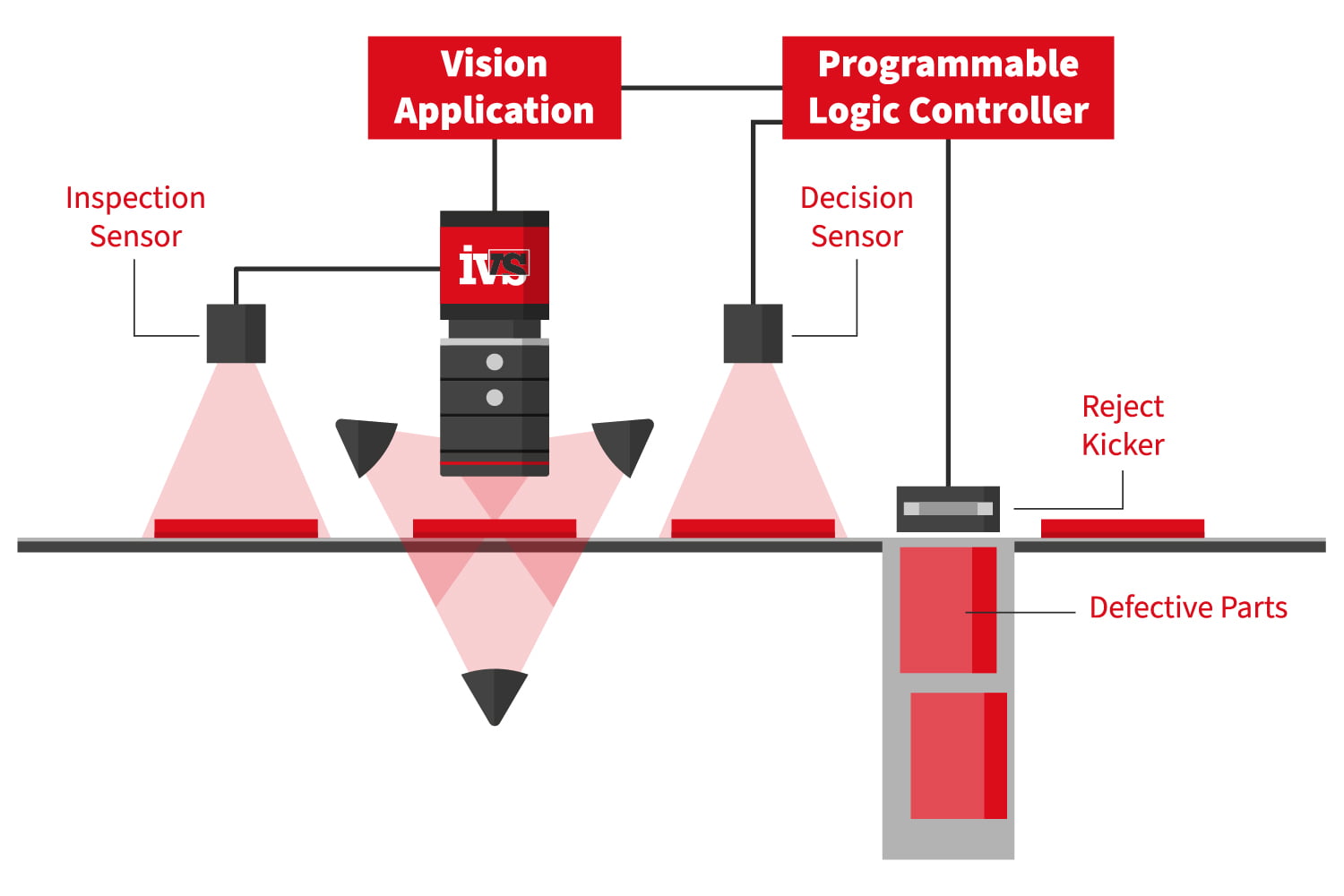
Continuous materials – paper, textiles, metal coil, glass, rubber sheeting – are the clearest case for line scan technology, since there is no natural frame boundary to synchronize an area scan exposure against. A converting line running printed film at 300 meters per minute simply cannot be inspected frame-by-frame with area scan optics without either accepting motion blur or resorting to strobed lighting and mechanical indexing that would slow the process unacceptably. Line scan cameras, synchronized to a rotary encoder on the drive roller, capture one line per fixed increment of material travel regardless of speed fluctuations, which keeps the image geometrically accurate even if line speed varies during acceleration or deceleration phases.

Round or cylindrical objects moving on a conveyor – pipes, cans, bottles – also benefit from line scan imaging when a full 360-degree unrolled view is required, since a rotating object passed beneath a line scan sensor produces a flattened image of the entire circumference, something an area scan camera cannot achieve without multiple cameras and complex stitching. Machine vision systems This unrolled-surface capability is particularly valuable in can and bottle inspection lines checking for label placement, seam integrity, or surface defects around the full diameter of the container. industrial cameras
Is Area Scan the Better Fit for Robotic Guidance and Discrete Parts?
Robotic pick-and-place and guidance applications almost always favor area scan sensors because the task requires understanding spatial relationships within a bounded scene – where is the part relative to the gripper, what is its rotational orientation, are there multiple overlapping components. Line scan imaging, which builds an image progressively as material moves, is poorly suited to a robot cell where parts may be stationary, randomly oriented in a bin, or moving unpredictably rather than at constant, encoder-tracked velocity. Area scan sensors paired with global shutter readout also avoid the rolling shutter distortion that would otherwise smear a fast-moving robotic arm or a part vibrating on a feeder track.
Global shutter area scan sensors capture every pixel at the same instant, which matters considerably when a system must measure the exact position of a part edge for robotic guidance; rolling shutter sensors expose row by row, which can introduce measurable geometric distortion on fast-moving objects even though rolling shutter sensors are often less expensive and offer higher pixel counts for the same cost. For static or slow-moving discrete inspection – checking labels on a stationary tray, verifying component placement on a PCB after reflow – the rolling shutter penalty is negligible, and integrators can reasonably choose the more economical sensor without compromising measurement accuracy.
What Does Total Cost of Ownership Look Like for Each Architecture?
Line scan systems typically carry a higher initial investment once lighting, encoder integration, and high-bandwidth frame grabbers are included, since the entire chain must be engineered as a synchronized system rather than a standalone camera. Area scan systems tend to have lower integration complexity but can require multiple cameras to cover a large part or a wide conveyor, which shifts the cost curve depending on inspection area rather than sensor sophistication. Maintenance costs also diverge: line scan lighting assemblies with concentrated optics are more sensitive to LED degradation over time and may need earlier replacement to maintain uniform illumination, while area scan flood lighting tends to degrade more gradually without producing visible artifacts until the drop-off is fairly severe.
Area Scan or Line Scan: How Do You Decide for Your Application?
| Attribute | Area Scan | Line Scan |
|---|---|---|
| Typical application | Discrete parts, robotic guidance, indexed inspection | Continuous webs, rotating cylindrical objects, high-speed coil |
| Image formation | Full 2D frame captured in one exposure | Built line-by-line as material moves past sensor |
| Speed limitation | Bound by frame rate (often 30-200 fps) | Bound by line rate (often 20,000-140,000 lines/sec) |
| Lighting requirement | Diffuse flood lighting across full field of view | High-intensity, narrow line lighting precisely aligned to FOV |
| Integration complexity | Lower; standalone camera often sufficient | Higher; requires encoder sync and frame grabber tuning |
Can a Hybrid Approach Combining Both Sensor Types Make Sense?
What Should You Verify Before Committing to a Camera Family?
- Confirm sustained (not peak burst) frame or line rate at your actual bit depth and resolution requirement, not the marketing headline figure.
- Verify interface bandwidth margin – running near 100% of GigE or CoaXPress capacity invites dropped frames under real plant conditions.
- Check encoder input compatibility for line scan triggering, including quadrature support and maximum pulse frequency.
- Request environmental ratings (IP rating, operating temperature range, vibration tolerance) matched to your installation site.
- Confirm long-term firmware and driver support commitments, especially for lines expected to run five-plus years without hardware changes.
Frequently Asked Questions
Can a line scan camera be used for stationary, indexed parts instead of area scan?
Technically yes, if the part or camera can be moved at a controlled velocity during capture, but this adds mechanical complexity that is rarely justified when a standard area scan camera can capture the same part in a single exposure with far simpler integration.
How much does encoder synchronization add to a line scan system’s cost?
Encoder integration, including the rotary encoder itself, mounting hardware, and the frame grabber’s triggering logic, typically adds a modest but real cost compared to a self-triggered area scan camera, though it is usually a small fraction of total system cost once lighting and optics are included.
What line speed typically justifies switching from area scan to line scan?
There is no single universal threshold, but once continuous material speed makes strobed area scan capture impractical or produces unacceptable motion blur at required resolution, line scan generally becomes the more reliable and cost-effective architecture.
Do line scan cameras require more powerful processing hardware than area scan?
Sustained high line rates can generate comparable or greater data throughput than area scan frame rates, so processing hardware and frame grabber bandwidth should be sized against actual data rate in megabytes per second rather than assumed based on sensor type alone.
Is global shutter always necessary for robotic guidance applications?
Global shutter is strongly preferred whenever the part or robot arm is in motion during capture, since rolling shutter distortion can introduce measurable position error, but for genuinely stationary parts under stable lighting, rolling shutter sensors can perform adequately at lower cost.
